

If you’re here, you’re probably thinking about investing your money for the future using investment funds.
Maybe you’ve never invested before. Maybe you’ve tried things like individual stocks or crypto and found it stressful, or had a bad experience. Either way, you’re in the right place to learn about how funds can accelerate your financial progress without needing to constantly watch the stock markets, or time an exit or entry price.
Understanding investment funds is one of the most important steps to investing confidently and we are here to help teach you everything you know to get started.
So, what is an investment fund?
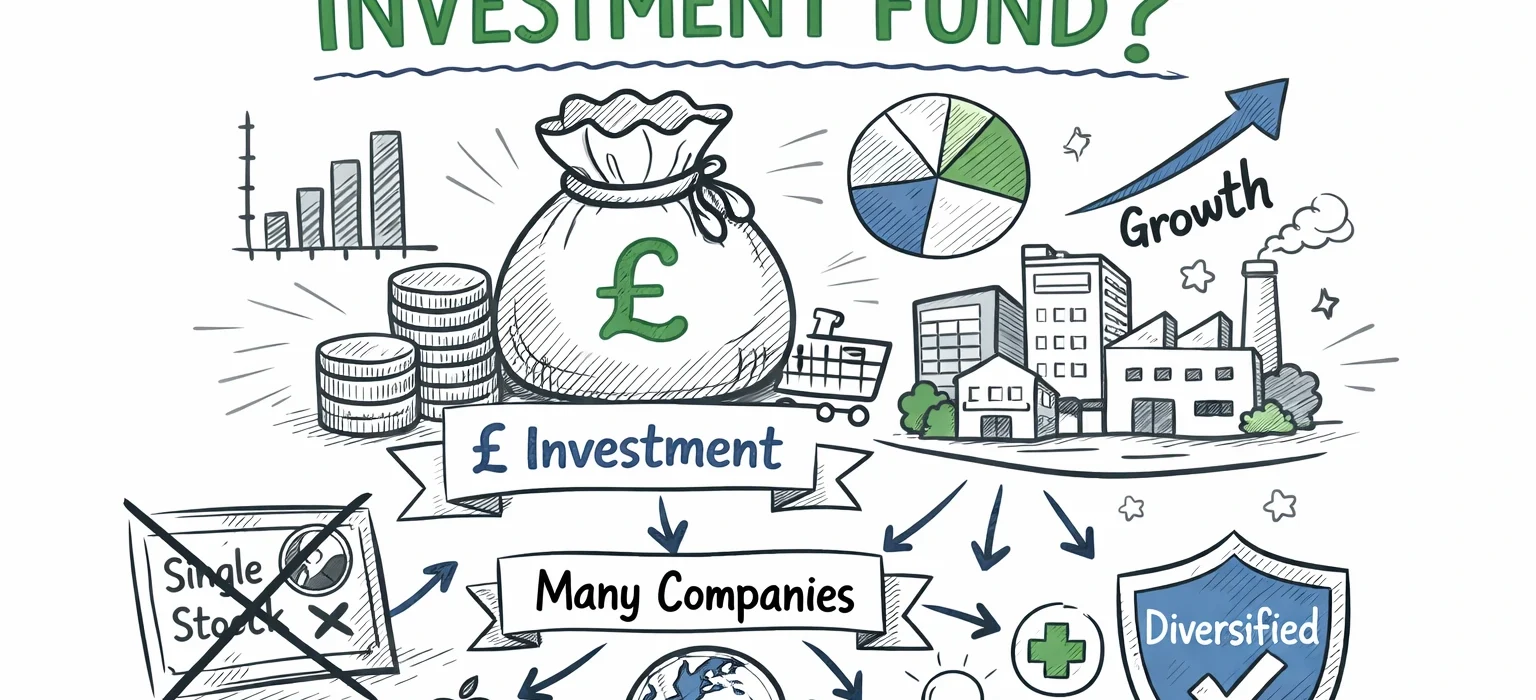
An investment fund is a single investment that owns lots of different companies at once.
Instead of choosing one company to buy shares in, you buy a small piece of many companies automatically.
Think of it as:
One investment → Hundreds or thousands of companies.
This approach reduces risk because you’re not relying on just one company to do well.
If one company performs badly, the others help balance it out
For example, if one company in the fund goes bankrupt and loses all its value, it might only make up around 0.25% of the fund.
So your overall investment would barely move because your money is spread across many other companies that continue to grow as part of the fund.
That’s what people mean when they talk about diversification, spreading your money out instead of betting on one thing. You’re buying many different assets when you buy funds.
Why does this matter?
- It makes investing simpler
- You don’t need to watch stock market prices all the time
- You don’t need to time an exist – you can just hold
- It reduces your investment risk
- It helps smooth out the ups and downs of the stock market
- And it allows your money to grow alongside businesses around the world
Funds are one of the easiest and most reliable ways for beginners to start investing, and it’s helped me tremendously and has changed my perspective from short term trading, to long term investing. You don’t need to constantly buy and sell. With funds, the goal is to invest and hold for many years, ideally decades, allowing your money to grow steadily over time through the power of compound interest.
Types of Investment Funds
There are two main types of funds:
| Fund Type | How it Works | Cost | Key Point |
| Index Fund | Tracks a stock market index (e.g. FTSE 100, S&P 500). It simply mirrors the market. | Low fees | Usually the simplest, lowest cost option. |
| Actively Managed Fund | A fund manager chooses which companies to buy and sell. | Higher fees | You’re paying for active management and decision making from the fund manager. |
Both give you diversification but index funds are generally cheaper and easier to understand, which is why many beginners start there. Personally, my entire portfolio has been built around index funds. I don’t need to bet on what fund manager is going to outperform the market, or its benchmark, I feel most comfortable tracking the market and leaving it alone.
I have personally held many index funds for over a decade. I only buy and rarely ever sell.
Example: What Investing in a Fund Looks Like
Let’s imagine you invest £1,000 in an investment fund that is diversified across 1,323 different stocks, with the top 10 holdings held mostly in the technology sector.
You don’t own those companies directly, but you own a tiny fraction of each of them through the fund.
| Company | Sector | % of Fund | Your £1,000 → Value in This Company |
| Apple | Technology | 4.2% | £42 |
| Microsoft | Technology | 3.9% | £39 |
| Nvidia | Technology | 3.2% | £32 |
| Amazon | Consumer / Tech | 2.9% | £29 |
| Alphabet (Google) | Technology | 2.5% | £25 |
| Meta (Facebook) | Technology | 1.9% | £19 |
| Tesla | Consumer / Tech | 1.4% | £14 |
| Broadcom | Technology | 1.2% | £12 |
| Berkshire Hathaway | Diversified | 1.1% | £11 |
| UnitedHealth Group | Healthcare | 1.0% | £10 |
Total in top 10 companies: ~£233 (23.3%)
Invested across all remaining 1,313 companies: ~£767 (76.7%)
Disclaimer: The information provided in the table is accurate as of 12/11/2025. While we strive for accuracy, details such as fees, fund performance, or other data may change over time. Please verify information with the fund provider before making any investment decisions.
If the value of these companies rises over time, the value of your fund rises too. And because your money is spread across more than a thousand companies, even if one company performs poorly in the fund, it has only a small effect on your overall investment.
This is the power of diversification, as you putting all your eggs in one basket and bet on one company’s success. You’re investing in the strength of many. As a set, there is a good chance they will all grow cumulatively together.
How I discovered investment funds
I was 18 years old when I made my first investment into the stock market, it was a single stock and I lost most of my money. The value declined quickly and I panicked, and sold.
From there, other losses followed and investing in the stock market started to feel more like gambling than building wealth. I didn’t really know what I was doing. I was just following a friend’s advice, speculating and analysing charts without a clear strategy.
I took a break and five years later, I landed a job at one of the UK’s leading investment platforms. That’s when I discovered investment funds and made my first fund investment.
I had just wished I found this approach to investing sooner, it truly is a more disciplined, structured, and accessible way to grow wealth, providing a sense of confidence and clarity that I had never experienced with individual stocks.
Disclaimer: The information above reflects our views and approach to investing. It is not a guarantee of future returns, and the value of investments can go down as well as up. Past performance is not indicative of future results, and individual outcomes may vary.